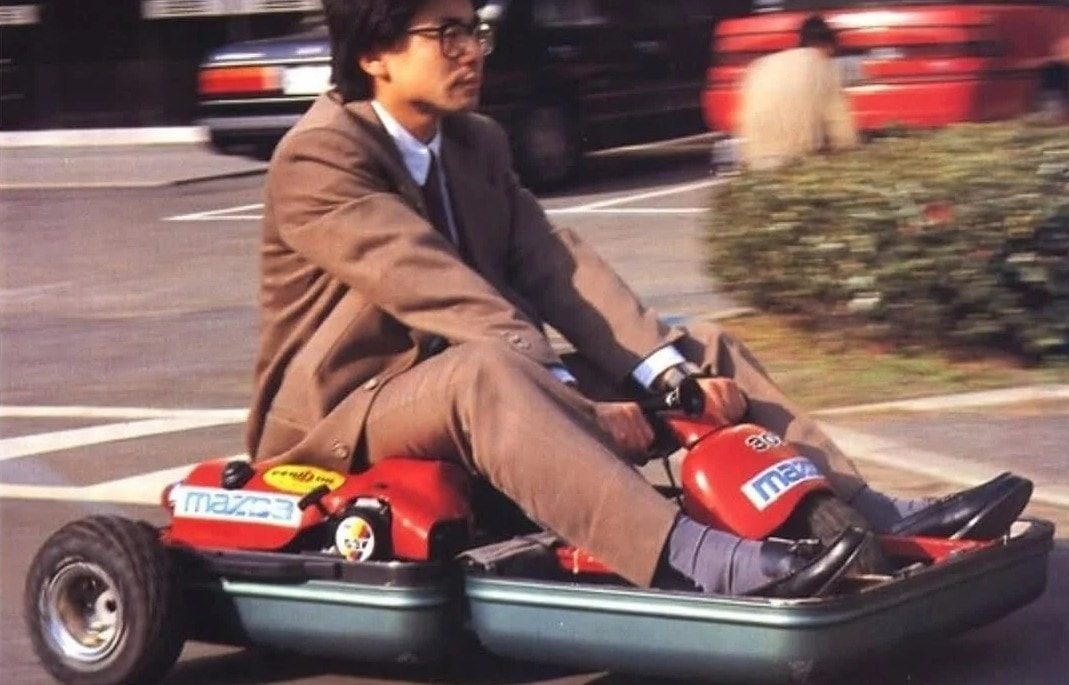
Mazda Suitcase Car
Mazda · 1991

Mazda Suitcase Car

—
Community scoreLoading…
Rate it

A real, rideable three-wheeler that folds into a hard-shell suitcase, built by a handful of Mazda engineers for an in-house ideas contest in 1991. Too heavy for the overhead bin and far too much fun to care, it is the most lighthearted thing Mazda has ever made.

Folding three-wheeled scooter packed in a hard-shell suitcase

Made by Mazda (built by its engineers for the in-house Fantasyard contest)

In the numbers
Power
2hp
Weight
32kg
71 lb
0–60 mph
—
Not on record
Top speed
22mph
Maker's claim
Built
3

Figures for the 1991 Mazda Suitcase Car, Fantasyard prototype (Mazda spec sheet). Sources are listed at the foot of the page.

The story

In 1991, riding high on the Miata and a Le Mans win, Mazda invited its staff to dream up new forms of mobility in a company competition called Fantasyard. A team of 7 engineers from the manual-transmission department answered with a motorized suitcase. They found an oversized Samsonite hard case, loaded it with the bones of a small 3-wheeled motorbike, and arranged things so the front wheel, rear wheels and seat could be deployed in under a minute. A 34 cc two-stroke made 1.7 hp, good for about 22 mph.

As luggage it made no sense. At 32 kg (70 lb) it belonged in the hold, and no security line would wave through a tank of gasoline. That was never the point. The contraption became a media darling, earning extra copies for Europe and the United States, and at a 1991 exhibition it reportedly drew bigger crowds than the Le Mans-winning 787B beside it. The original was later wrecked and the European car has vanished, leaving the US example as the lone survivor of the most cheerful idea Mazda ever let its engineers build.

The community verdict

Loading the score…

What's your verdict?

Loading…

From Carveyance

More from Mazda

Where the numbers come from

Figures are for the 1991 Mazda Suitcase Car, Fantasyard prototype (Mazda spec sheet). Numbers come from the Carveyance stories about this car, which were checked when they were written, and where a story didn't give one, from the sources below. A dash means we haven't found a figure we trust.

Spotted something wrong?

Tell us which number or fact, and where you saw the right one. We check every note.