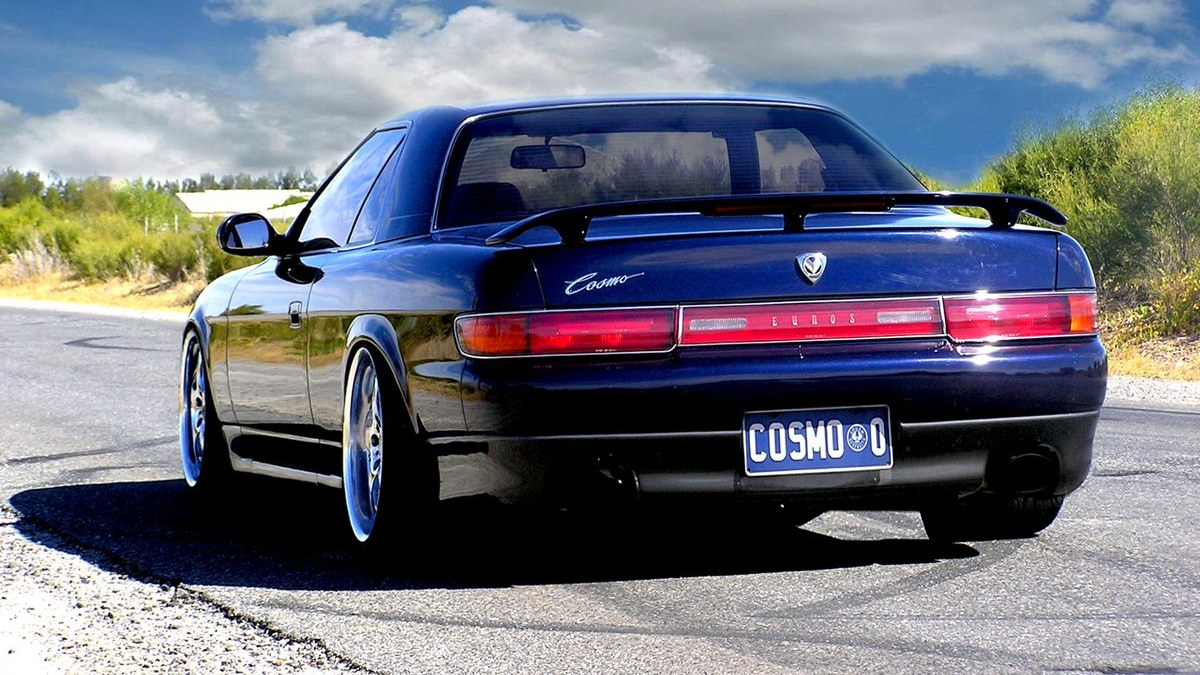
Eunos Cosmo

Photo: MrWalkr / Wikimedia Commons, CC BY-SA 4.0

Mazda · 1990–1995

Eunos Cosmo

Also sold as Mazda Eunos Cosmo, Mazda Cosmo (JC)

—
Community scoreLoading…
Rate it

The only production car ever powered by a three-rotor rotary, wrapped in a long, quiet luxury coupe with a color GPS touchscreen years ahead of its time. Built for Japan's boom years and launched just as the boom ended, it remains Mazda's most extravagant road car.

Two-door 2+2 coupeRear-wheel drive4-speed automatic

Made by Mazda, sold under its Eunos badge

In the numbers
Power
276hp
Weight
1,610kg
3,549 lb
0–60 mph
6.5sec
Maker's claim
Top speed
158mph
Estimate
Built
8,875

Figures for the 1990 Eunos Cosmo 20B (three-rotor), Japanese market. Sources are listed at the foot of the page.

The story

The Eunos Cosmo was Mazda's bid to stand beside Jaguar and Mercedes-Benz, and it went about it in a thoroughly Mazda way. Under a long, unadorned hood sat either a twin-rotor 13B or the 20B, 3 rotors fed by sequential turbochargers and rated on paper at 280 PS (276 hp), a ceiling set by a Japanese industry agreement rather than by the engine. Inside, the top Type-E carried a color touchscreen running GPS navigation, audio, phone and climate from a single display, a pairing no production car had offered before.

On the road it is a grand tourer, not a sports car. The second turbo joins in with a smooth swell rather than a jolt, the cabin stays hushed, and the long body prefers fast sweepers to tight switchbacks, where its size and its 4-speed automatic, the only gearbox offered, get in the way. Mazda sold it only in Japan, and the bubble that paid for it burst almost as soon as it arrived: 4,325 were built in 1990, just 331 in 1995. It lost money and won admirers, and the 20B never powered another road car.
The community verdict

Loading the score…

What's your verdict?

Loading…

From Carveyance

Also appears in: You Spin Me Round · The Middle Child

More from Mazda

Where the numbers come from

Figures are for the 1990 Eunos Cosmo 20B (three-rotor), Japanese market. Numbers come from the Carveyance stories about this car, which were checked when they were written, and where a story didn't give one, from the sources below. A dash means we haven't found a figure we trust.

Photo: MrWalkr / Wikimedia Commons, CC BY-SA 4.0

Spotted something wrong?

Tell us which number or fact, and where you saw the right one. We check every note.