The story
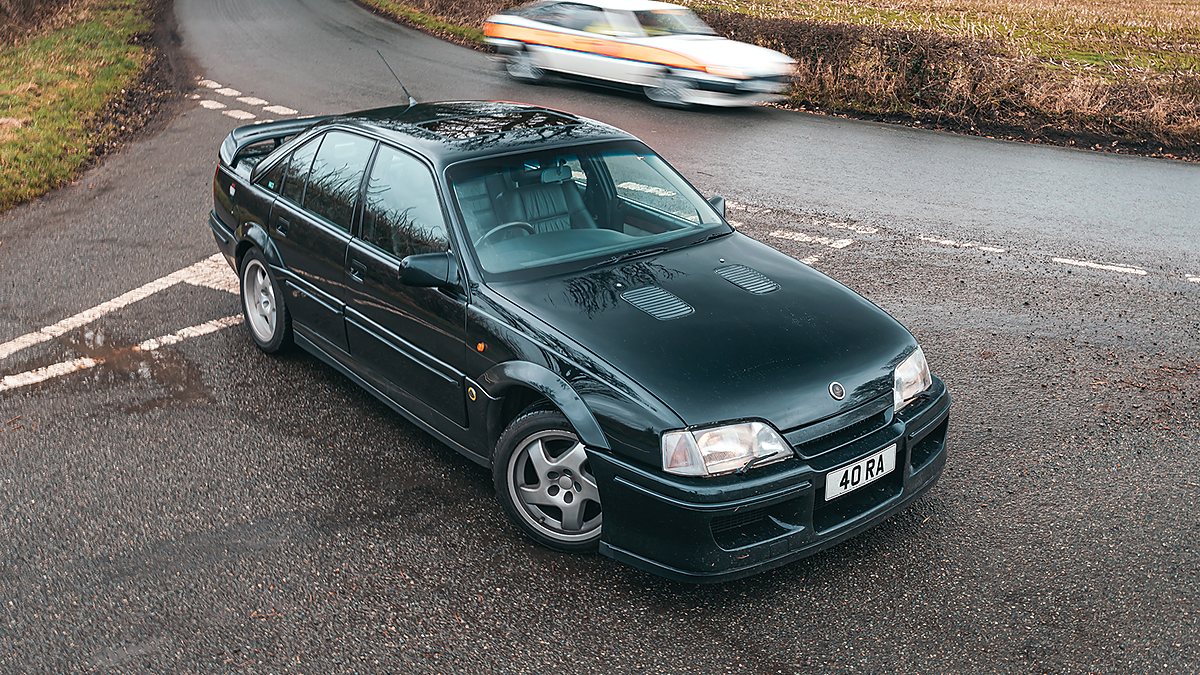
In 1990 there was no less likely supercar than a Vauxhall Carlton. Lotus took the executive sedan, enlarged its straight-6 to 3.6 liters and added 2 Garrett turbochargers, a 6-speed manual from the Corvette ZR-1, an Australian limited-slip differential, big AP brakes, fiberglass arch extensions and a rear wing. The result weighed about 1,655 kg (3,650 lb), reached 60 mph in 5.1 seconds and, Vauxhall said, 176 mph. Police chiefs, safety campaigners, a national newspaper and 2 Members of Parliament condemned it, and ram-raiders chose one because nothing in a police fleet could keep up.
The people who actually drove it told a quieter story. The engine was muted, the clutch brutally heavy and the gearshift slow, and the car produced its enormous speed with so little fuss that period testers found it oddly unexciting. Its brakes were judged the best yet fitted to a road car, it covered 20,000 miles in a long-term test without a fault, and its trunk still swallowed a family's luggage. Time has been kind. Beside modern, software-filtered cars, its unhurried manner now reads as a virtue. Only 950 were built, 320 Carltons and 630 Opel Omegas, every one painted Imperial Green.