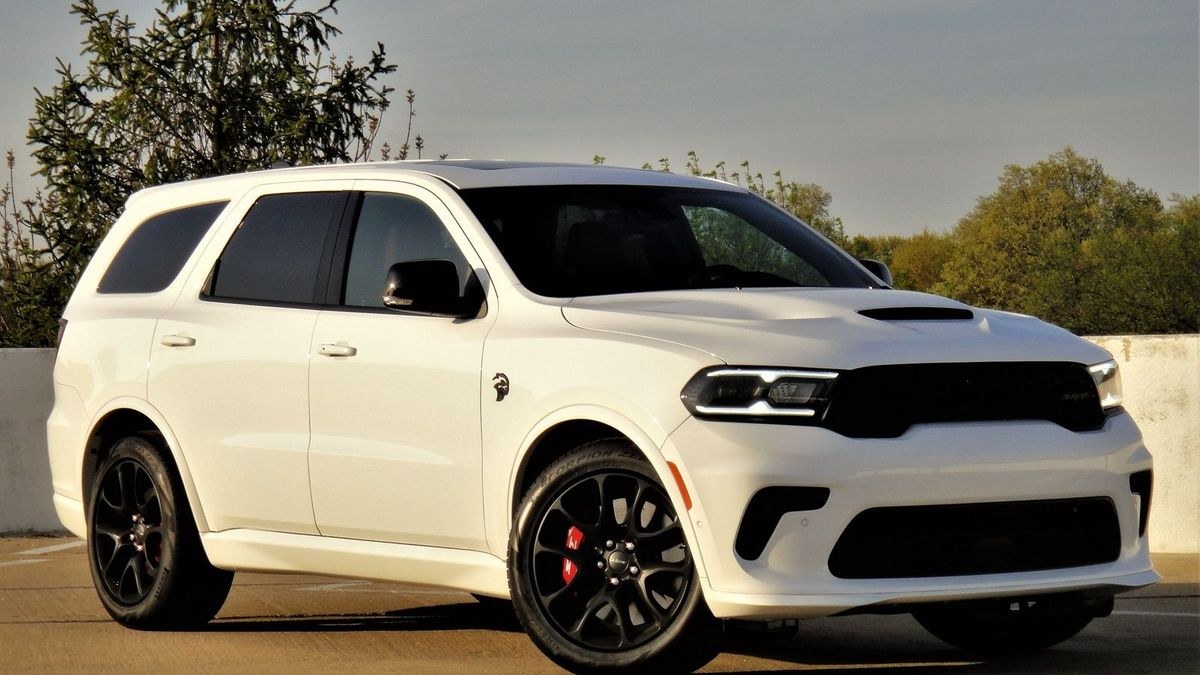
Dodge Durango (third generation)

Photo: Alexander Migl / Wikimedia Commons, CC BY-SA 4.0

Dodge · 2011–present

Dodge Durango third generation

—
Community scoreLoading…
Rate it

Dodge's 3-row SUV moved onto Grand Cherokee-based unibody bones for 2011 and then simply refused to go away, piling on ever-bigger V8s up to a 710-hp supercharged Hellcat. More than 15 years on, it is selling better than ever and carrying most of the Dodge brand on its back.

4-door, 3-row SUVAll-wheel drive8-speed automatic

Made by Dodge

In the numbers
Power
710hp
Weight
2,510kg
5,534 lb
0–60 mph
3.5sec
Maker's claim
Top speed
180mph
Maker's claim
Built
—
Not on record

Figures for the 2021 Dodge Durango SRT Hellcat. Sources are listed at the foot of the page.

The story

The third-generation Durango dropped the truck frame of its predecessors and borrowed much of its underbody from the Jeep Grand Cherokee, keeping rear-drive proportions, V8 power and serious towing while finally gaining a civilized ride and a cabin worth sitting in. Then Dodge kept turning the dial. An 8-speed automatic arrived in 2014, the SRT with its 6.4-liter HEMI in 2018, and in 2021 the supercharged 6.2-liter Hellcat, with 710 hp, a claimed 0-60 mph time of about 3.5 seconds and the same 3,946 kg (8,700 lb) tow rating.

Its age has turned into an advantage. Rivals have downsized to turbo sixes, fours and hybrids, leaving the Durango almost alone as an attainable V8 family hauler, and it still offers 4 engines running from sensible V6 to gloriously unhinged. It keeps proper buttons, it drinks heavily, and owners adore it anyway. In 2025, its best year since 2005, it accounted for roughly 80 percent of everything Dodge sold in America. A successor is planned, and it inherits a very hard act to follow.
The community verdict

Loading the score…

What's your verdict?

Loading…

From Carveyance

More from Dodge

Where the numbers come from

Figures are for the 2021 Dodge Durango SRT Hellcat. Numbers come from the Carveyance stories about this car, which were checked when they were written, and where a story didn't give one, from the sources below. A dash means we haven't found a figure we trust.

Photo: Alexander Migl / Wikimedia Commons, CC BY-SA 4.0

Spotted something wrong?

Tell us which number or fact, and where you saw the right one. We check every note.